
Earth Day 2026
Care for the Earth
ARTWORKARTICLEPOETRY
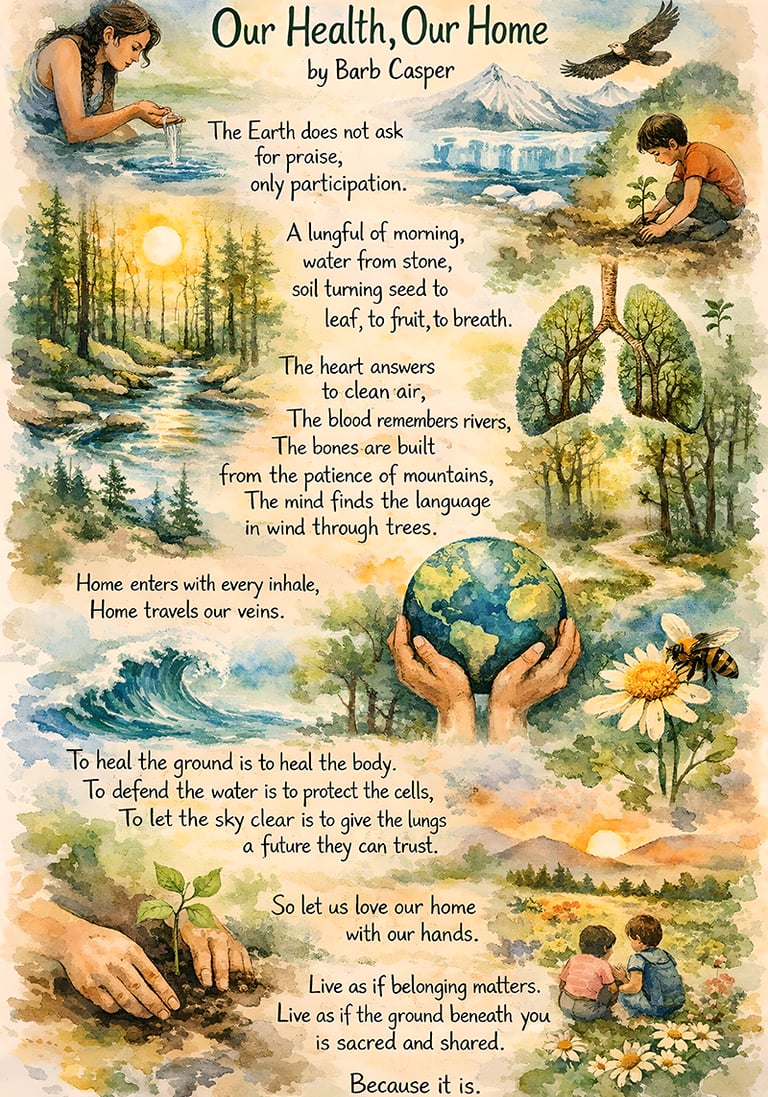
Honoring the Earth, Healing Ourselves
Humanity and nature are not separate realms, but threads of the same sacred tapestry, breathing one life through many forms. The rivers that move across the Earth, the forests that lift their green prayers to the sky, and the oceans that cradle ancient memory all sustain us in ways both visible and unseen. The air that fills our lungs, the water that blesses our bodies, the soil that nourishes our food, and the plants that offer healing are not merely resources to be used, but gifts entrusted to our care. In every leaf, every seed, every drop of rain, there is a quiet teaching: that our lives are bound to the living world in a covenant of reciprocity.
When we honor the Earth, we honor ourselves, for our bodies and spirits are shaped by the health of the world around us. A flourishing planet brings vitality to human life, while wounded lands and polluted skies echo their suffering through our own physical, emotional, and spiritual well-being. The natural world restores something ancient within us. Green spaces soothe the restless mind, birdsong softens the heart, and the presence of trees reminds us how to stand rooted and reach upward at once. Yet when humanity forgets this sacred kinship, imbalance follows. Climate disruption, ecological harm, and the unraveling of biodiversity are not only environmental crises, but spiritual warnings, calling us back into right relationship with the living Earth.
Earth Day arrives, then, not only as a date upon the calendar, but as a ritual of remembrance. It is a holy pause, a day that invites humanity to awaken to its shared responsibility as guardian rather than conqueror. Since its beginning, this observance has grown into a global invocation, gathering millions in acts of service, restoration, and reverence. Through collective intention, it has inspired movements, laws, and international promises born from the understanding that the wounds of the planet know no borders. The call of Earth Day is clear: to recognize that the healing of the world begins with the willingness to listen, to care, and to act.
Around the world, people answer this call in humble and beautiful ways. They plant trees as offerings to the future, cleanse neighborhoods and shorelines as acts of devotion, gather in learning and celebration, and recommit themselves to more conscious ways of living. No gesture is too small when performed with sincerity. To recycle, to conserve water, to reduce waste, to support local growers, to walk more gently upon the land—these are not trivial habits, but daily rituals of stewardship. Through such acts, we participate in the restoration of balance, becoming co-creators in the renewal of the world.
To nurture the planet is also to nurture the soul. When we choose simplicity over excess, mindfulness over mindlessness, and reverence over indifference, we begin to remember who we are. Sustainable living is not merely a practical discipline; it is a spiritual path, one that teaches gratitude, restraint, and interconnectedness. Compost returned to the soil becomes a symbol of transformation. Reusable objects become signs of intention. Supporting local ecosystems becomes a way of blessing the ground beneath our feet and the communities around us. In caring for the Earth, we rediscover a deeper rhythm of belonging.
Compassion for the world opens the heart in every direction. As we become more tender toward the land, the waters, the creatures, and the air, we often find ourselves becoming more tender toward one another and toward our own inner lives. Nature reflects to us the truth of interdependence: that nothing thrives alone, and that healing is always shared. To sit beneath the sky, to walk among trees, to witness the quiet intelligence of the natural world is to remember that we, too, are part of a vast and sacred whole.
In the end, this path asks us to live with deeper awareness—to see the Earth not as backdrop, but as beloved presence; not as property, but as living kin. It asks us to understand that every choice we make sends a ripple through the web of life. And it offers a profound realization: that the care we extend to the world is also the care we extend to ourselves. In protecting the Earth, we protect the conditions for beauty, for health, for peace, and for future generations to inherit a world still rich with wonder. Through reverence, compassion, and conscious action, we may yet restore harmony, walking forward as humble stewards of a living, sacred planet.Humanity and nature are not separate realms, but threads of the same sacred tapestry, breathing one life through many forms. The rivers that move across the Earth, the forests that lift their green prayers to the sky, and the oceans that cradle ancient memory all sustain us in ways both visible and unseen. The air that fills our lungs, the water that blesses our bodies, the soil that nourishes our food, and the plants that offer healing are not merely resources to be used, but gifts entrusted to our care. In every leaf, every seed, every drop of rain, there is a quiet teaching: that our lives are bound to the living world in a covenant of reciprocity.
When we honor the Earth, we honor ourselves, for our bodies and spirits are shaped by the health of the world around us. A flourishing planet brings vitality to human life, while wounded lands and polluted skies echo their suffering through our own physical, emotional, and spiritual well-being. The natural world restores something ancient within us. Green spaces soothe the restless mind, birdsong softens the heart, and the presence of trees reminds us how to stand rooted and reach upward at once. Yet when humanity forgets this sacred kinship, imbalance follows. Climate disruption, ecological harm, and the unraveling of biodiversity are not only environmental crises, but spiritual warnings, calling us back into right relationship with the living Earth.
Earth Day arrives, then, not only as a date upon the calendar, but as a ritual of remembrance. It is a holy pause, a day that invites humanity to awaken to its shared responsibility as guardian rather than conqueror. Since its beginning, this observance has grown into a global invocation, gathering millions in acts of service, restoration, and reverence. Through collective intention, it has inspired movements, laws, and international promises born from the understanding that the wounds of the planet know no borders. The call of Earth Day is clear: to recognize that the healing of the world begins with the willingness to listen, to care, and to act.
Around the world, people answer this call in humble and beautiful ways. They plant trees as offerings to the future, cleanse neighborhoods and shorelines as acts of devotion, gather in learning and celebration, and recommit themselves to more conscious ways of living. No gesture is too small when performed with sincerity. To recycle, to conserve water, to reduce waste, to support local growers, to walk more gently upon the land—these are not trivial habits, but daily rituals of stewardship. Through such acts, we participate in the restoration of balance, becoming co-creators in the renewal of the world.
To nurture the planet is also to nurture the soul. When we choose simplicity over excess, mindfulness over mindlessness, and reverence over indifference, we begin to remember who we are. Sustainable living is not merely a practical discipline; it is a spiritual path, one that teaches gratitude, restraint, and interconnectedness. Compost returned to the soil becomes a symbol of transformation. Reusable objects become signs of intention. Supporting local ecosystems becomes a way of blessing the ground beneath our feet and the communities around us. In caring for the Earth, we rediscover a deeper rhythm of belonging.
Compassion for the world opens the heart in every direction. As we become more tender toward the land, the waters, the creatures, and the air, we often find ourselves becoming more tender toward one another and toward our own inner lives. Nature reflects to us the truth of interdependence: that nothing thrives alone, and that healing is always shared. To sit beneath the sky, to walk among trees, to witness the quiet intelligence of the natural world is to remember that we, too, are part of a vast and sacred whole.
In the end, this path asks us to live with deeper awareness—to see the Earth not as backdrop, but as beloved presence; not as property, but as living kin. It asks us to understand that every choice we make sends a ripple through the web of life. And it offers a profound realization: that the care we extend to the world is also the care we extend to ourselves. In protecting the Earth, we protect the conditions for beauty, for health, for peace, and for future generations to inherit a world still rich with wonder. Through reverence, compassion, and conscious action, we may yet restore harmony, walking forward as humble stewards of a living, sacred planet.
Our Power, Our Planet
by Barb Casper
Earth Day can feel huge. Climate change, pollution, habitat loss, waste, and water quality are not small problems, and most people don't have the power to solve them alone. But that is exactly why the 2026 Earth Day message matters: real change grows when ordinary people act together. “Our Power, Our Planet” is not just a slogan. It's a reminder that local choices, shared habits, and community work can add up to real environmental resilience.
So what can you do?
Start close to home. Pick one habit you can sustain: recycle correctly, cut down on single-use plastics, compost food scraps, walk or bike for short trips, plant native species, or reduce home energy waste. These actions are modest on their own, but they become powerful when neighborhoods, schools, workplaces, and cities do them together.
Then go one step further: show up. Join a cleanup, attend an expo, volunteer for a park project, or bring children to a hands-on nature event. Public participation matters because it turns concern into culture. When people gather around rivers, parks, trails, schools, and community spaces, they do more than beautify a place. They build the kind of local pride and cooperation that helps communities protect air, water, trees, and public health over time.
Earth Day is also a good time to learn. Ask where your recycling goes. Find out how stormwater affects the Saginaw Bay watershed. Talk with local conservation groups, educators, and sustainability advocates. Learning is action when it changes what you buy, how you manage your health, how you vote, how you volunteer, and what you teach the next generation. Learn about being an advocate for the health of our planet and our personal health and well-being.
Most of all, do not wait for perfect. Environmental action does not have to be dramatic to be meaningful. Fill one bag of litter. Attend one event. Volunteer one morning. Plant one tree. Support one organization doing good work. The planet is protected not only by sweeping policies and big inventions, but by communities that decide their place is worth caring for.

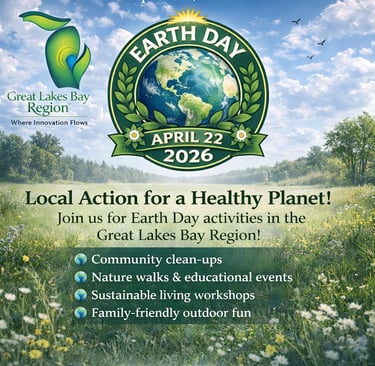
Earth Day 2026 - Great Lakes Bay Region
As of March 20, 2026, these are the clearest publicly posted local or nearby Earth Day activities I was able to find (please check links/sources closer to the events):
Bay City’s Earth Day Celebration — Saturday, April 25, 2026, 9:00 a.m.–2:00 p.m. at the Transfer Station-Recycling Center, 2900 N. Water St., Bay City. This is a practical cleanup-and-recycling event offering recycling, paper shredding, tire disposal, appliance recycling rebates for qualifying items, and other drop-off services.
Official City of Bay City event listing for the April 25 community recycling and cleanup event: Bay City Earth Day CelebrationBay County United Way Day of Caring — Friday, April 24, 2026, 8:00 a.m.–12:00 noon with registration at 7:30 a.m. at Wenonah Park, 103 Center Ave., Bay City. In honor of Earth Day, volunteers are assigned to cleanup and beautification projects around the community, including park work and nonprofit service projects; breakfast, lunch, and most tools are provided.
Volunteer information for the April 24 cleanup and beautification projects held in honor of Earth Day: Bay County United Way Day of CaringDowntown Bay City – Day of Caring project — Friday, April 24, 2026, 8:00 a.m.–12:00 noon at the Washington/6th and Saginaw/5th parking lots in Bay City. This specific Day of Caring site focuses on planting grasses and plants in downtown beds, making it a nice fit for people who want a hands-on greening project rather than a drop-off event.
Earth Action Expo 2026 (Midland) — Saturday, April 25, 2026, 10:00 a.m.–3:00 p.m. at Dow High School, Midland; The expo is described on its official site as a free, family-friendly sustainability event with dozens of environmentally minded organizations, renewable-energy information, electric vehicles, rescued wildlife, and activities focused on sustainable living.
Official site for the free sustainability-focused expo featuring environmental organizations, activities, and community resources: Earth Action ExpoVernal Pool Exploration at Chippewa Nature Center (Midland) — Wednesday, April 22, 2026, 6:00–7:00 p.m. at the Visitor Center. This free all-ages program explores temporary ponds and contributes to the Vernal Pool Patrol community-science effort, making it a good Earth Day option for families who want a nature-based activity.
Program details for the April 22 nature exploration event connected to community science and habitat awareness: Chippewa Nature Center Program PageForest Therapy Walk: Earth Connections at Chippewa Nature Center (Midland) — Thursday, April 30, 2026, 5:00–7:00 p.m. at the Visitor Center. This free guided “forest bathing” walk is for adults and ties Earth Day to mindfulness and connection with place; registration is required by April 28. Chippewa Nature Center – Forest Therapy Walk: Earth Connections: Forest Therapy Walk Event Listing
Regional Events Roundup: A Great Lakes Bay Region community roundup that includes additional seasonal event references: Our Midland Events Roundup


MISSION STATEMENT
Our purpose is to provide ethical energy medicine that reconnects you with the flow of life and vibrant well-being.
We support your transformation journey through intuitive practices, sacred tools, and compassionate care. Rooted in the oneness of all existence, we honor the sacred dance of mind, body, and spirit.