The Many Faces of Peace
What Peace Asks of Us
ARTICLEPOETRYARTWORK
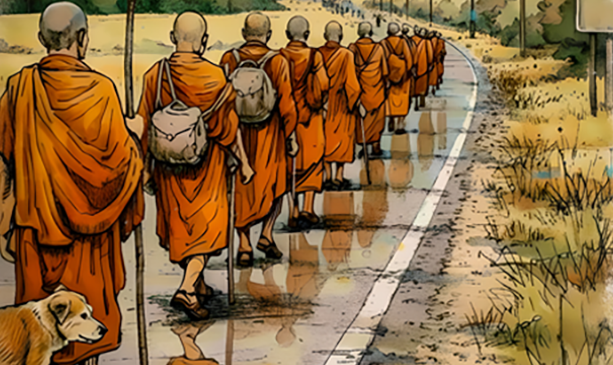
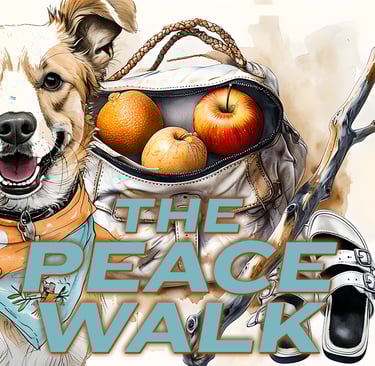
After reading about the Buddhist monks and their current "Walk for Peace", a 2,300 mile journey across America, I found myself asking what the word peace is really asking of us.
Peace isn’t only the quiet after a storm, or the absence of shouting, or the end of war. It is a many-named thing—sometimes a breath you can finally take, sometimes a door that can finally open.
Some of us are reaching for inner peace, the steadiness that doesn’t shatter when life does.
Some want peace of mind, the relief of knowing what’s been broken is mended—or at least held with care.
Some are longing for interpersonal peace, the softening of old resentments, the return of respectful speech.
Others are pleading for community peace, where streets feel safe, and neighbors feel like neighbors again.
And beyond the self, beyond the home, there is the wider hunger: civil peace that steadies a country, international peace that quiets borders, and just peace—not merely silence, but fairness; not order, but dignity.
So when the monks walk, step after step, it feels like they are carrying a truth the body understands: peace is not a single destination. It is a path with many forms—and each of us arrives seeking a different kind of peace.
It didn’t begin with fanfare—
only a road
and intention.
October 26, 2025:
Fort Worth let them go
like breath
released on purpose
as if the city exhaled
and meant it.
Robes—
a moving line of saffron,
the country’s long shoulder
learning to soften,
learning the holy art
of stillness in motion.
Ahead: Washington, D.C.,
not as a trophy—
Instead, a point on the map
where a promise arrives
still barefoot,
still human,
still made of promise.
Two thousand three hundred miles—
a number that behaves
until you live inside it:
day after day,
ten states of horizon,
the slow, methodical prayer
of endurance—
the kind that asks no applause,
only breath.
They carry little.
Not because they have nothing—
because peace can’t be packed
without breaking its seams.
The soul travels lighter
when it means to stay.
One meal.
A patch of ground beneath trees.
A kindness offered roadside—
water, fruit, a wave
that whispers without words:
I see you.
I bless your journey.
And the quiet discipline of it—
walking as meditation,
silence as shelter,
each step an unarmed answer,
each footfall
a small refusal
to become what harms.
Beside them,
a dog with a rescued history—
Aloka,
once stray,
now steady as a vow.
Sometimes he walks.
Sometimes he rides.
Always, he returns to the line,
because devotion has a heartbeat, four paws,
and a home it keeps choosing.
Traffic slows.
Phones lower.
Hands unclench.
Faces change in real time.
Strangers stand shoulder to shoulder and remember
they belong to one another
for the length of a passing moment—
long enough
to be altered.
Because when peace is visible—
not argued,
not branded,
not sold—
something simple and radical happens:
it makes the heart recognizable.
Not their hearts only—
ours, too:
the ones we hide
behind loud voices
and tightened fists.
The peace we keep waiting for
is not a headline.
It’s a lifestyle—
a daily practice of fewer weapons,
lighter burdens,
cleaner speech,
steadier mercy.
Peace isn’t absence of conflict;
it’s the presence of choice
when conflict arrives:
the pause, the breath,
the turned-down volume,
the hand that does not strike.
It is the work
of carrying less rage,
So we can carry more care.
It is learning
that the truest border
is the one we draw
inside our own chest—
erasing it
one inch at a time.
And if nineteen-plus robes
and one small dog
can move through weather
and still bless the roadside—
still offer their bodies
as prayer—
then surely
each of us can carry
one quiet portion of peace
within our ribs,
and let it live there
as a way of walking
through the world.
Not someday.
Not when the world behaves.
Today, with empty hands.
Today,
with an unbroken step.
What Peace Asks of Us
by Barb Casper


MISSION STATEMENT
Our purpose is to provide ethical energy medicine that reconnects you with the flow of life and vibrant well-being.
We support your transformation journey through intuitive practices, sacred tools, and compassionate care. Rooted in the oneness of all existence, we honor the sacred dance of mind, body, and spirit.